
From the dedication page of “Worlds’ War 1898“
This is a Wargame that is inspired by the work of H.G. Wells. H.G. Wells actually wrote one of the early wargames for British children when he wrote “Little Wars,” despite being a Pacifist. He seemed to be of the opinion that his game would help make people aware of the reality of War:
And if I might for a moment trumpet! How much better is this amiable miniature than the Real Thing! Here is a homeopathic remedy for the imaginative strategist. Here is the premeditation, the thrill, the strain of accumulating victory or disaster—and no smashed nor sanguinary bodies, no shattered fine buildings nor devastated country sides, no petty cruelties, none of that awful universal boredom and embitterment, that tiresome delay or stoppage or embarrassment of every gracious, bold, sweet, and charming thing, that we who are old enough to remember a real modern war know to be the reality of belligerence. – H.G. Wells Little Wars
Given that the game was published in 1913, it can be said the game did not have immediate success.
H.G. Wells, a utopian, was deluded into believing that World War I was a “war to end War,” a sort of beginning to what, after the Cold War many years later, idealists would call “the end of history.”
I am not sure what H.G. Wells would think of this game, as it is both a compliment and critique of his views on war. It is a compliment to him in that, given that he helped popularize wargaming, it is only fair that his works be honored in the hobby, and it is surprising to me that no popular mainline games have so far done this (at least at large scale, successfully).
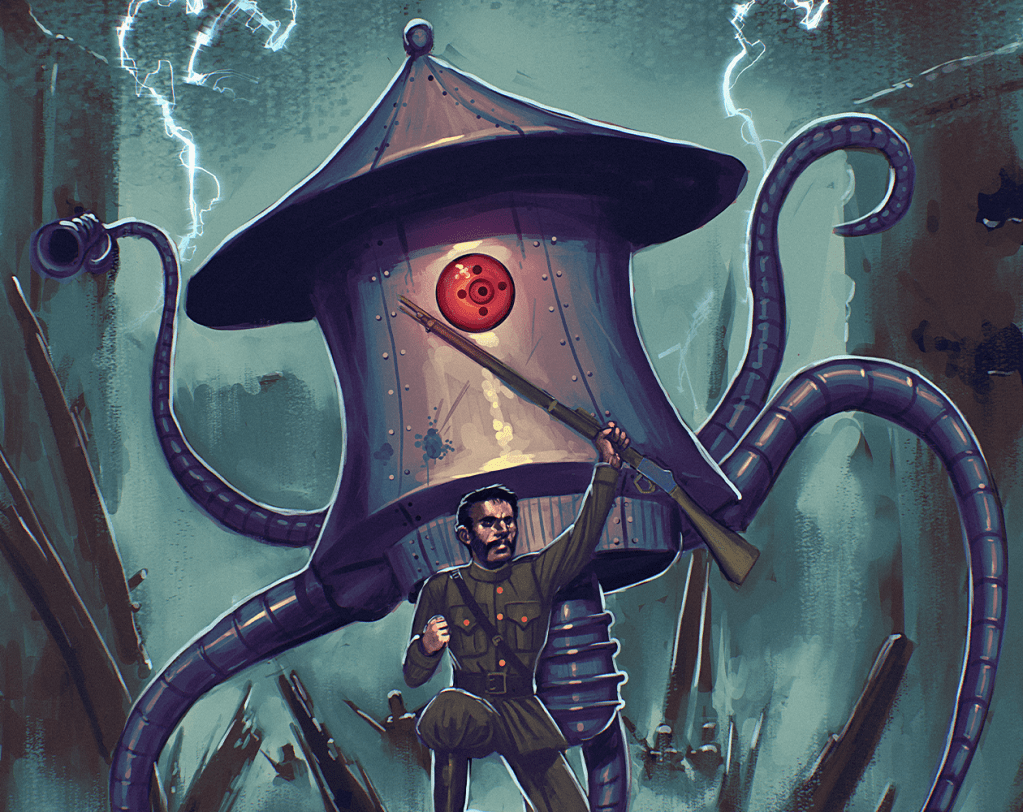
The game is a critique in that it depicts a world where history does not end. The delusion that while humans walk this Earth there can . . . or even should . . . be an end to history is nowhere to be tolerated here. A Martian invasion itself could not bring about an end to history, and in this game’s premise, the War of the Worlds does not unite man but kickstarts early World War I.
But this game is also not a grimdark Warhammer 40K. In the Alliance of Man, and in other factions as well, there are good people, broken people, human people. People who believe, as the heroes of the World Wars believed, that freedom is worth fighting for. God has, given the broken human condition, used war to raise up heroes, expose villains and advance the human story.
There is another respect in which H.G. Wells might not have liked this game. H.G. Wells also wrote in his “Little Wars”
THIS little book . . . is not a book upon Kriegspiel. . . . . But it has a very distinct relation to Kriegspiel; and since the main portion of it was written and published in a magazine. . . [Military correspondents] tell me—what I already a little suspected—that Kriegspiel, as it is played by the British Army, is a very dull and unsatisfactory exercise, lacking in realism, in stir and the unexpected, obsessed by the umpire at every turn, and of very doubtful value in waking up the imagination, which should be its chief function. – H.G. Wells Little Wars
The rules of this game are, probably much to his chagrin, done out of respect for the 1824 Krieggspiel by Von Reisswitz, which has a design that I think has been too readily abandoned by today’s commercial war games.
It (Krieggspiel) was in desperate need of simplification, of course, and I hope these simplified rules capture its spirit in a way that, hopefully, is of use in “waking up the imagination.”
See the development of Worlds’ War 1898: https://muckraker.itch.io/worlds-war-1898

 The Martian Muckraker
Leave a comment